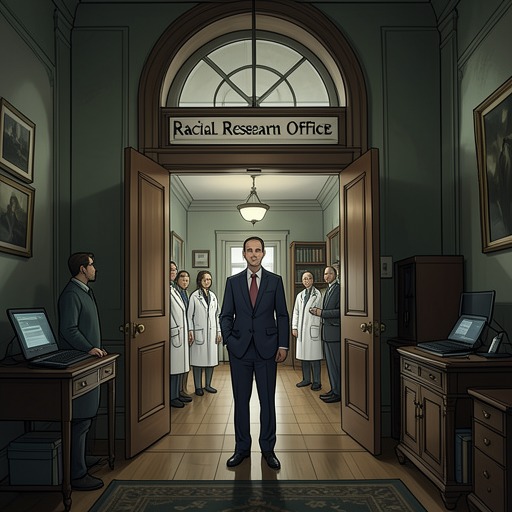
Nazi racial classification order
The Glass RoomNazi racial classification order is the apparatus through which the occupying regime tries to convert racial ideology into scientific fact and administrative practice. At the biometric centre installed in the Landauer House, people are entered into forms, measured, photographed, and reduced to sortable records. The cool precision of the procedures disguises a system built to classify human beings by a political doctrine—and to make those classifications consequential.
From racial doctrine to institutional practice
The centre’s director, Stahl, presents its work as a scientific endeavour. Addressing his staff as pioneers, he insists that they must act first and foremost as scientists, even as he links the supposed frontiers of knowledge to the advancing frontiers of the Third Reich. This pairing reveals the order’s central contradiction: the institution borrows the language of discovery and professional restraint while serving a regime whose racial categories are already ideological commitments.
The transformation of the house gives that contradiction a material form. Upstairs rooms become offices, the kitchens are converted into a laboratory, and a basement room is prepared for an X-ray machine. Curtains divide the Glass Room; measurement equipment stands before the onyx wall, while photography lights and a camera turn the dining area into a studio. The Bösendorfer piano remains, incongruously, a remnant of the house’s former life. The same architectural space that once embodied modernist proportion now stages the measurement and recording of human subjects.
The machinery of classification
People arrive in groups and are guided through the centre without overt shouting or military force. The routine is presented as orderly and respectful, but its subjects have little control over the process. A form records their birth dates and birthplaces, languages, religion, race, and nation, alongside illnesses and conditions attributed to their ancestry, including alcoholism, criminality, and mental retardation. Confidentiality and pure science are invoked as assurances, even as the institution gathers intimate information for racial classification.
The examination proceeds in stages. Subjects complete tests involving shapes, sequences, and patterns, change into medical gowns, give blood by needleprick, and have their blood pressure taken. Staff work in pairs: one positions each person at the stadiometer while another records the results. Height, hip and chest diameter, limb measurements, and head dimensions are taken with callipers. Examiners compare skin colour with a von Luschan chart and match eye colour against model eyes. The body is made legible through standardized measurements, while the subject’s anxious, living gaze meets the instruments’ impersonal scrutiny.
Photography completes the sequence. Subjects are told to remove their gowns and are reassured that the examination is scientific and the records confidential. Stahl watches as the process unfolds. The narrative’s emphasis on exactness—the measurement made to seem as perfect as the dimensions of the Glass Room—exposes how neutrality itself becomes part of the performance. Standardization may make the records consistent; it does not make the questions, categories, or purposes impartial.
Categories, data, and contradiction
The system seeks combinations of bodily traits that might produce a racial diagnosis, but its own proponents acknowledge the limits of that ambition. Asked whether a single characteristic can distinguish a Jew from someone of Nordic stock, Stahl answers that there is no single character. He tells Reinhard Heydrich that the centre instead measures minute variations in phenotype and searches for combinations that might be sorted by Hollerith machines. The claim to scientific discrimination thus depends not on a decisive marker but on assembling many uncertain observations into a pattern.
The centre’s records feed a larger administrative network. In one monthly return, 672 people are classified: 316 Slav, 239 Aryan, and 112 Mischlinge of varying degrees, with Roma and Jews accounted for separately in an addendum. Punched cards are duplicated and sent to Prague, then on to Berlin, where machines sort and assemble them at a rate of 150 cards per minute. This scale and speed lend the project an appearance of impersonal inevitability. Yet the figures remain products of choices about who is counted, what categories apply, and which characteristics are treated as meaningful.
The centre also exposes the instability beneath its claims. When Heydrich asks whether the work can identify Jews, Stahl mentions hair colour and inherited diseases, including infantile amaurotic idiocy and Gaucher’s disease, but concedes that not all Jews have such conditions and that people with them are not necessarily Jews. The distinction undermines any simple biological test even as the institution continues searching for combinations of traits. Its methods cannot establish the clean boundaries its ideology demands, yet the failure does not stop the collection and use of data.
Human consequences and narrative significance
The order’s categories are not abstractions to the people caught within them. When the possibility of racial classification is defended as a way to preserve racial purity, Liesel counters that her children, Ottilie and Martin, are healthy and normal. The argument shows how an official label can reach into family life: the children are described as Mischlinge, and the doctrine treats their ancestry as a threat regardless of their actual condition. The state’s classification does not discover a danger; it defines one.
The institution’s power also depends on unequal access to safety and authority. At the border, Katalin’s refugee passport and visas do not protect her from being taken away. When Viktor protests, an official warns him to move back onto the train unless he wants to be detained. Katalin and her daughter Marika are led towards a hut while Liesel pulls the frightened child close and promises that they will look after her. The scene is not a laboratory examination, but it echoes the centre’s logic: documents and official judgments determine whose identity is accepted and whose movement can be stopped. The administrative appearance of order cannot guarantee protection to those it classifies as outsiders.
The novel therefore places the rhetoric of measurement beside scenes of personal exposure, coercion, and separation. The classification system’s polished forms and exact instruments do not stand apart from racial persecution; they help give persecution an administrative vocabulary. Its central irony is that the institution claims to reveal fixed racial identities while repeatedly confronting uncertainty—and then treats that uncertainty not as a reason to abandon its premises, but as an invitation to collect more data and exercise greater power.